


7 Experts, 7 Questions, 7 Answers
7 Experts, 7 Questions, 7 Answers: Each expert will share their perspective on a specific issue that is of particular concern for sustainable supply chain finance The second edition of the Supply Chain Finance Hub, hosted by Prof. Dr. David Wuttke – Assistant...Orbian Issues Guidance to Clients on Global “IBOR” Transitions
What is LIBOR? Interest rates can be fixed or alternatively calculated by reference to benchmark rates. The London Interbank Offered Rate (LIBOR) is one of the most used benchmarks for interest rates and is referenced in financial products such as derivatives, bonds,...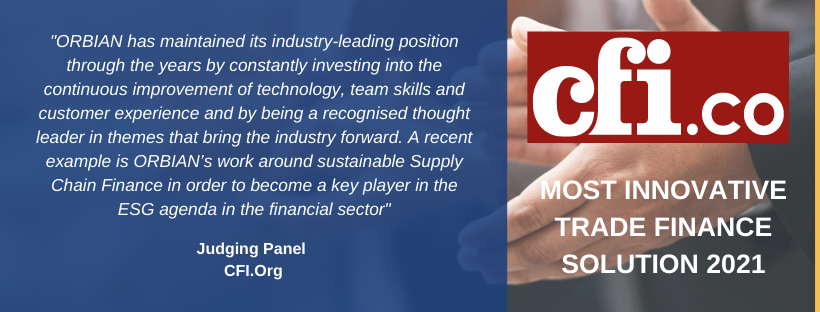
Orbian Named Most Innovative Trade Finance Solution Global 2021 by CFI.co
The CFI.co judges recognize Orbian with the 2021 global award for Most Innovative Trade Finance Solutions. “Orbian is the longest tenured Supply Chain Finance (SCF) provider. They have been providing SCF solutions for over 20 years and financing over $230 billion in...
A New Dawn for the Climate Economy
In this session broadcasted on TXF, Peter McKillop, Founder of Climate & Capital Media and Thomas Dunn, Chairman at Orbian discussed green economy, the impact of the Biden presidency on the climate agenda, the continuing impact of the Covid pandemic, the...Orbian Releases Environmental, Social & Governance Research Report
Supply chains are one of the most important levers for businesses to have a positive impact across a broad ESG agenda. Download Orbian’s ESG Report and schedule a conversation with us about the working capital benefits of Orbian supply chain finance that will satisfy your corporate ESG agenda.